 (425) 348-8484
Options for Missing Teeth – Which is Right For You?
 by Harbour Pointe Family Dentistry
✓ We accept Delta Dental, Primera & most major insurance · Boeing employees welcome View insurance & financing →
The three most common ways to replace missing teeth are dental implants, fixed bridges, and dentures, and the right choice depends on how many teeth are missing, the health of your jawbone and gums, and your budget. If you are dealing with a gap in your smile, eating certain foods can feel impossible, and photos are the last thing you want taken. The good news is that every one of these options can restore a natural-looking, functional smile.
Tooth loss is more common than most people realize. According to the National Institute of Dental and Craniofacial Research, adults ages 50 to 64 are missing an average of nearly 4 teeth, up from less than 1 missing tooth in adults in their twenties, and the number climbs with age. At Harbour Pointe Family Dentistry, we walk Mukilteo patients through these options every week, and this guide breaks down how each one works.
Why Replacing Missing Teeth Matters
Replacing a missing tooth is about more than appearance. Teeth act as placeholders for one another, and when one goes missing, the surrounding teeth begin to shift out of position. Over time, this can create bite problems because your teeth no longer line up the way they should.
There is also a structural side to this. The bone and gum tissue beneath a missing tooth begin to lose density without a tooth root to stimulate them, which can weaken the teeth next to the gap and eventually lead to further tooth loss. Addressing a gap sooner rather than later helps protect the teeth you still have.
Comparing Your Options
Each replacement option involves a different process, timeline, and cost. Here is how the three most common choices compare:
| Option | Best For | Typical Lifespan | Key Advantage |
|---|---|---|---|
| Dental Implants | Single or multiple missing teeth with adequate bone | Decades, with proper care | Preserves jawbone and does not alter neighboring teeth |
| Fixed Bridges | One or a few missing teeth in a row | 10 to 15 years on average | No surgery, and it stays in place permanently |
| Dentures | A full arch of missing teeth | 5 to 10 years, or longer with implant support | Lowest upfront cost for full-arch replacement |
Dental Implants
An implant replaces the root of a missing tooth with a small titanium post placed in the jawbone, which is then capped with a custom porcelain crown. Because the post fuses with the surrounding bone, dental implants help prevent the bone loss that comes with an untreated gap, and they do not require any alteration to the healthy teeth next to them. With proper care, implants can last decades.
Fixed Bridges
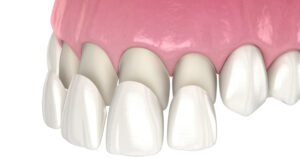
A fixed bridge uses one or more artificial teeth anchored to the natural teeth on either side of the gap, either through bonding or dental crowns. Bridges look and function like natural teeth, do not need to be removed for cleaning, and typically cost less upfront than implants. They are a good option when the teeth next to the gap already need dental crowns, since the bridge and crowns can sometimes be planned together. You can see the process in more detail on our dental bridges page.
Dentures
When most or all of the teeth in an arch need replacing, dentures are typically the least expensive option. Modern denture materials look natural and function well for eating and speaking, and dentures can be removed for cleaning and repairs. Patients who want more stability can consider implant-retained dentures, which snap onto a small number of implants for a more secure fit.
What the Implant Process Looks Like
STEP 1
Consultation and imaging to evaluate bone density and plan implant placement.
STEP 2
The implant post is placed in the jawbone during a short in-office procedure.
STEP 3
Healing time allows the post to fuse with the surrounding bone.
STEP 4
A custom crown is attached, completing the restoration.
The Choice Is Yours
Each of these options can restore your ability to eat what you want and smile with confidence. The best option for you depends on your budget, oral health, and personal preference, and our team can walk through financing through our financing options page or review general costs on our pricing page. Talk to your dentist about which option fits your unique circumstances.
Curious how implants compare to your natural teeth day to day, or whether you are a candidate at all? We cover both in more detail in Do Dental Implants Work Like Real Teeth? and Can Anyone Get Dental Implants?
Frequently Asked Questions About Replacing Missing Teeth
Which is better, a dental implant or a fixed bridge?
Implants tend to last longer and preserve the jawbone better because they replace the tooth root, but they require adequate bone and a longer overall timeline. Fixed bridges work well when the neighboring teeth are already healthy or need crowns, and they typically cost less upfront. Your dentist can recommend the better fit after an exam.
How long does it take to get a dental implant?
The full process, from placement through healing to the final crown, generally takes a few months because the implant needs time to fuse with the jawbone. Some patients qualify for a faster timeline depending on bone health and the location of the missing tooth.
Am I a candidate for dental implants if I have lost bone density?
Adequate bone is important for a standard implant, but options such as bone grafting can rebuild the area first in many cases. An evaluation with imaging is the only way to know for certain, so it is worth discussing even if you have been told no in the past.
Are dentures a permanent solution?
Traditional dentures are removable and typically need to be relined or replaced every five to ten years as your mouth changes shape over time. Implant-retained dentures attach to a small number of implants and tend to stay more stable for longer.
What happens if I just leave a missing tooth alone?
Neighboring teeth can drift into the open space, your bite can shift out of alignment, and the jawbone beneath the gap tends to lose density over time. Addressing a missing tooth earlier generally means simpler, less costly treatment than waiting.
Every option here can restore your confidence and function, and none of them requires guesswork on your part. Bring your questions to your next visit, and our team will walk through the pros, cons, and cost of each path based on your own mouth.
Contact us to schedule a consultation and find the right option for your smile.